
The Indian services sector growth touched an 11 month high in July, supported by a pickup in new exports orders and sharp rise in overall sales, a monthly survey said on Tuesday. The seasonally adjusted HSBC India Services PMI Business Activity Index was at 60.5 in July, little-changed from 60.4 in June, and the rate of expansion was the best seen since August 2024.
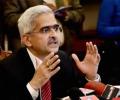
All members of the Monetary Policy Committee (MPC) -- Shashanka Bhide, Ashima Goyal, Jayanth R Varma, Mridul K Saggar, Michael Debabrata Patra and Shaktikanta Das -- had unanimously voted to keep the policy repo rate unchanged at 4 per cent after the three-day meet of the panel earlier this month. Further, except Varma, other members voted to continue with the accommodative stance as long as necessary to revive and sustain growth on a durable basis and continue to mitigate the impact of COVID-19 on the economy, while ensuring that inflation remains within the target going forward. Varma expressed reservations on this part of the MPC resolution, according to the minutes.

All six members of the Reserve Bank of India's (RBI's) monetary policy committee (MPC) expressed caution over food inflation during the December review, while two external members warned about high real interest rates as headline inflation approaches its target of 4 per cent. The central bank continued to maintain the status quo on both the repo rate and the stance in the December monetary policy. India's retail inflation in November rose to 5.5 per cent - its fastest pace in three months - due to higher food prices.

Clarity on Tata Sons' position on listing, as of 2025, would help define the future of the group better, irrespective of the RBI stand. As of now, the ball is in the RBI's court, and everyone is watching the space, points out Nivedita Mookerji.
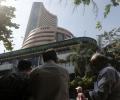
Financials emerged as the top gainers while auto shares rallied on robust September sales

High frequency indicators, like vehicles sales, air traffic, steel consumption and GST E-way bills, point towards a sequential pickup in momentum of economic activity during the second half of the fiscal 2024-25 and sustain moving forward, RBI Bulletin said on Wednesday. However, a strong dollar, driven by US economic resilience and trade policy pivots, could exacerbate capital outflows from emerging economies, push risk premiums higher, and intensify external vulnerabilities, said an article on 'State of the Economy' published in RBI's February bulletin.

Reserve Bank on Thursday retained the growth and inflation projection at 7.2 per cent and 4.5 per cent respectively for the current fiscal amid expectations of a normal monsoon. In its last bi-monthly monetary policy review in June, RBI had projected real GDP growth and retail inflation at the same.

The Reserve Bank of India, which is scheduled to review the monetary policy on October 30, should not do anything that might make the economic fundamentals of the country uncomfortable, former RBI governor Bimal Jalan said on Tuesday. The central bank is facing a tough task of keeping the economic growth going while keeping inflationary pressures under control.

In an eventful week ahead, stock markets may face volatile trends before the RBI's interest rate decision and the US inflation data announcements, as investors continue to assess the broader implications of US tariffs on global economy and inflation, analysts said. Investors fear that a full-blown trade war will impact global trade and economic growth, according to market experts.

Members of the Monetary Policy Committee (MPC) felt that though the Indian economy was resilient in the third wave, it, however, lost some momentum and with inflation likely to soften, there is room to continue with the accommodative stance and support revival, the minutes of the MPC meeting released on Thursday revealed. The six-member MPC voted to keep the policy rate unchanged and continued with the accommodative stance at its meeting on February 10. However, external member Jayanth Verma voted against the stance because he felt a switch to neutral was long overdue and the current stance has become counterproductive and deflects focus away from addressing recessionary trends that date back to at least 2019.

Despite gross domestic product (GDP) growth being lower-than-expected for the July-September quarter, the six-member Monetary Policy Committee (MPC) may not cut the policy repo rate in the review meeting scheduled for next week due to high inflation in October, according to experts. "Consumer Price Index (CPI) inflation breaching the upper limit of the RBI's tolerance band in October (6.2 per cent year-on-year) is not a favourable backdrop for the MPC to commence the easing cycle, even as the growth outcome disappointed the MPC's expectations," said Shreya Sodhani, regional economist at Barclays, who expects the policy repo rate to be kept unchanged in the December meeting.

Indian corporates collectively raised over Rs 17,500 crore from the domestic debt capital market through bond issuances on Tuesday. The issuances were led by Bharti Telecom's Rs 10,500 crore fundraise in two tranches, the largest by an Indian company in the domestic market so far in FY26.

The move is aimed at making settlement of claims or return of articles from a locker smooth for relatives after the death of a customer.

The Reserve Bank is likely to maintain status quo on interest rates in its forthcoming monetary policy review but may change the stance in view of retail inflation piercing its upper tolerance limit, global uncertainties created by the ongoing Russia-Ukraine war, and the urgency to protect and boost growth, feel experts. The RBI governor-headed rate setting panel -- Monetary Policy Committee (MPC) -- will be holding its first meeting of the 2022-23 fiscal from April 6 to 8. The outcome will be announced on April 8.
The Reserve Bank of India on Friday raised the GDP growth projection for the current fiscal to 7 per cent from 6.5 per cent earlier on buoyant domestic demand and higher capacity utilisation in the manufacturing sector. Announcing the bi-monthly monetary policy, RBI Governor Shaktikanta Das, however, flagged protracted geopolitical turmoil and global economic fragmentation as risks to the growth outlook. The RBI kept interest rates unchanged at 6.5 per cent in Friday's monetary policy statement.
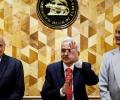
'The central bank has highlighted that the slowdown in growth has been limited to a few sectors and overall growth is expected to pick up in the second half of the year.'

Nestle India was the top laggard in the Sensex pack, shedding around 2 per cent, followed by SBI, HDFC Bank, Axis Bank, ICICI Bank, Reliance Industries, HUL and Dr Reddy's. NSE Nifty slipped 20.10 points to 15,670.25.
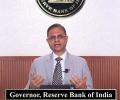
'India has the potential to grow at more than 7%, with the monetary policy providing a supportive hand.'

Equity markets this week will turn their focus on the RBI's interest rate decision, Q1 earnings from several blue-chip firms and tariff-related news for further cues, analysts said. Moreover, trading activity of foreign investors and trends in global equity markets will also drive investors' sentiment.

The rising core inflation might result in an inter-policy decision by RBI to raise policy rates. Core inflation is a measure of inflation which excludes certain items, particularly food and energy, which face volatile price movements.

The Urjit Patel committee on monetary policy framework has proposed setting up of a monetary policy committee (MPC) that will be headed by the Reserve Bank of India (RBI) governor and accountable for achieving inflation target set by it.

The Reserve Bank of India on Thursday kept the benchmark interest rate unchanged at 4 per cent and decided to continue with its accommodative stance against the backdrop of an elevated level of inflation.

Many analysts argue with limited space for a fiscal stimulus, the burden of lifting growth lies squarely on monetary policy.

Finance Minister Nirmala Sitharaman is scheduled to address the post-budget meeting of the RBI's central board on Monday and highlight key points of the Union Budget 2022-23, including the fiscal consolidation roadmap and high capex plan. It has been a custom that the finance minister addresses the RBI board, consisting of RBI Governor and existing four deputy governors, after the Budget. The meeting has been scheduled for February 14 where she would be addressing the board members and talk about announcements made in the Budget to perk up growth hit by three waves of COVID-19, sources said.
The bank is due to review the monetary policy on July 30.

The Reserve Bank of India's (RBI's) state of the economy report observed that any durable alignment of headline retail inflation with the target of 4 per cent could recommence in the second half of FY25 and sustain until numbers closer to the target are seen during the course of FY26, dashing hopes of any reduction in the policy repo rate in the current financial year. The report, authored by RBI staffers, including Deputy Governor in charge of monetary policy Michael Patra, said though headline numbers may fall in July and August due to base effect, it is likely to reverse in September.

The Reserve Bank of India (RBI) has barred four non-banking finance companies (NBFCs), including two microfinance institutions (MFIs), from sanctioning and disbursing loans for charging exorbitant interest rates to the borrowers. These four entities are Asirvad Microfinance, Arohan Financial Services (also an MFI), DMI Finance, which provides personal, consumption, and micro, small and medium enterprises loans, and Flipkart co-founder Sachin Bansal's Navi Finserv, which offers home and personal loans. The ban will take effect on October 21 to "facilitate closure of transactions in the pipeline", the regulator said in a statement.

Pressure has been mounting on the Reserve Bank of India to cut interest rates in the wake of declining retail inflation and the need to fuel growth momentum. However, the RBI will have to do a tightrope walk as globally interest rates are inching upwards.

Indian economy is in a sweet spot, with a mix of solid growth and moderating inflation, Moody's Ratings said, forecasting a 7.2 per cent GDP growth in the 2024 calendar year and 6.6 per cent in the next. In its Global Macro Outlook 2025-26, the rating agency said the global economy has shown remarkable resilience in bouncing back from supply chain disruptions during the pandemic, an energy and food crisis after the Russia-Ukraine war began, high inflation and consequent monetary policy tightening.

The RBI is likely to raise CRR, the portion of funds that banks have to keep with the regulator, by 50 basis points in its forthcoming monetary review next week and signal tight monetary measures, says Moody's.

Zombies a.k.a perpetually loss-making firms in India seem to have dampened the effectiveness of monetary policy at the margin as they use borrowed resources more for their survival than for undertaking new investment, according to a RBI study. The monetary policy does not hinder the creative destruction process by misallocating credit flows to zombies during periods of economic slowdown, showed a study by officers of Reserve Bank of India. It has been published in RBI's bulletin for February 2022. In India, zombie firms are estimated to account for about 10 per cent of total debt of the non-financial corporate sector.

The Reserve Bank of India on Friday revised upwards the GDP growth projection for the current fiscal to 7.2 per cent from 7 per cent on rising private consumption and revival of demand in rural areas. Unveiling the bi-monthly monetary policy, RBI Governor Shaktikanta Das said estimates released by the National Statistical Office (NSO) placed India's real gross domestic product (GDP) growth at 8.2 per cent in 2023-24. "During 2024-25 so far, domestic economic activity has maintained resilience," he said, adding that manufacturing activity continues to gain ground on the back of strengthening domestic demand.

Host of lenders led by State Bank of India (SBI) and Bank of India hiked lending rates after the Reserve Bank raised the benchmark interest rate to tame inflation. The hike has been effected in their benchmark rate linked to the repo rate, which increased by half a percentage point to 5.9 per cent. Even financial institutions like mortgage lender HDFC Ltd hiked the lending rate by 50 basis points effective Saturday.

The Reserve Bank on Friday retained inflation projection at 4.5 per cent for the current financial year, lower than 5.4 per cent in the last fiscal. Assuming a normal monsoon this year, CPI (consumer price index-based) inflation for the current year is projected at 4.5 per cent, with Q1 at 4.9 per cent, Q2 at 3.8 per cent, Q3 at 4.6 per cent, and Q4 at 4.5 per cent.

Equity benchmarks extended their decline for the fourth straight session on Wednesday, with the Sensex falling 214.85 points after the Reserve Bank raised the key interest rate by 50 basis points. Continuous foreign fund outflows and surging crude oil prices also weighed on markets. The 30-share BSE benchmark dropped 214.85 points or 0.39 per cent to settle at 54,892.49.

The rupee tumbled 3 per cent against the US dollar in 2024 as concerns over slower economic growth and a stronger greenback in global markets weighed, but it was among the least volatile currencies in the world and the headwinds may be less intense in the coming year.
During the fourth quarter of last fiscal, the economy had grown at a nine-year low rate of 5.3 per cent. During the entire fiscal of 2011-12, the economy grew by 6.5 per cent.
S&P Global Ratings on Tuesday said the Indian economy is set for "resilient growth" in 2025 and projected inflation pressure to recede which will lead to "modest" easing of the monetary policy by the RBI. In its India outlook for 2025, S&P also retained India's growth forecast for current fiscal at 6.8 per cent, followed by 6.9 per cent growth in 2025-26.

Among the Sensex constituents, 20 stocks ended the session in green with HDFC Bank, Titan, Tech Mahindra, and Asian Paints being the major gainers. TCS, Maruti, Kotak Mahindra Bank and Bajaj Finserve were the other gainers. In contrast, SBI, Bharti Airtel, JSW Steel, PowerGrid, ITC and Reliance closed the trading with losses.

In its scheme of things, tackling inflation now comes ahead of ensuring growth in the world's sixth largest economy, points out Tamal Bandyopadhyay.
